
A solemnisation may look simple from the outside, but in Singapore it sits at the intersection of law, logistics, venue coordination, and family expectations. If you lock in décor, outfits, and photography before you lock in the legal process, you can easily end up with a date that does not fit the official notice period, a solemniser who is unavailable, or witness and document issues that surface too late. Singapore’s official marriage journey makes clear that civil and Muslim marriages each follow specific application steps, timing rules, and day-of requirements, so the ceremony works best when planning starts with compliance first and styling second.
That matters not only for peace of mind, but also for the guest experience. When the legal steps are settled early, couples can design the ceremony with confidence: who needs to be present, when signing happens, how the lunch or dinner flows, and whether a single venue can handle both the solemnisation and the celebration. That is usually where a well-organised banquet venue becomes useful, because it reduces handoffs between too many vendors and moving parts.
Build the legal timeline first
For a civil marriage, the current official overview says you must submit your marriage application at least 21 days before the solemnisation date, and the earliest you can submit it is 6 months ahead of the ceremony. The same official overview also states that if any party is not a Singapore citizen or permanent resident, at least one of the parties must have been physically present in Singapore for 31 continuous days before the marriage application is submitted. That means your first real planning task is not venue shopping. It is checking whether your intended date is legally workable.
For a Muslim marriage, the planning window is different. The official Muslim marriage process states that the earliest solemnisation date is 21 days after submission, and the application lasts 150 days from the submission date. The current ROMM process materials also state that, from November 2025, marriage applications must include supporting documents. For Muslim couples, this makes early preparation even more important, because your wali, witnesses, supporting documents, and Kadi or Naib Kadi-related steps all affect the pace of planning.
A practical way to avoid stress is to treat your solemnisation date like a project deadline with dependencies. First, check the application window. Then check solemniser or Kadi availability. Then confirm the venue. Couples often do this in the reverse order, and that is where avoidable reshuffling begins. Singapore’s OMJ tools include an official application date calculator for both civil and Muslim marriages, which is exactly the kind of tool worth using before any deposit is paid.
Lock the people and paperwork before the styling
Once the date is realistic, the next priority is the people who make the ceremony legally valid. For a civil offsite solemnisation, OMJ requires you to indicate the date, time, venue, and solemniser details, and you can search for and invite a solemniser through the portal. On the solemnisation day itself, the solemniser checks the NRICs or passports of the bride, groom, and two witnesses, and will ask both parties to give verbal consent to the marriage. That is why names, ID numbers, and witness availability should be confirmed early, not the week before.
For Muslim marriages, the required circle is wider. The official process states that the groom, bride, wali, and two witnesses must be present on solemnisation day, and the materials also list items and details such as witness particulars, maskahwin, and hantaran as part of the solemnisation planning flow. For cases that require an appointment with ROMM, the official guide says the documents must be in original or certified true copy, and translated into English or Malay if the originals are not in either language.
This is the part many couples underestimate. Flowers can be swapped. A backdrop can be simplified. But a witness who turns up with the wrong ID, a wali issue that has not been clarified, or a mismatch between your application and your actual ceremony details can derail the day far more quickly than any styling issue. Singapore’s marriage process is designed to be digital and structured, but that only helps if the input details are accurate from the start.
A practical checklist you can actually use
Use this as your working solemnisation checklist, especially if you are planning an offsite ceremony and meal on the same day:
- Decide whether your solemnisation falls under ROM or ROMM and work from the correct legal timeline from the beginning. Civil and Muslim marriages do not run on the same planning windows.
- Check the official application date calculator before confirming your date. This gives you a realistic planning window before you commit to vendors or guests.
- Book your solemniser, Kadi, or Naib Kadi early and make sure the booking is accepted, not just requested.
- Confirm witness details exactly as shown on their NRIC or passport. Civil solemnisation requires two witnesses; Muslim solemnisation requires two witnesses and the presence of the wali where applicable.
- Prepare all required IDs and supporting documents in one folder and do not leave translations or supporting paperwork to the last minute.
- Decide how the ceremony will flow before you brief the emcee, photographer, or venue team. Signing, vows, family photos, and meal service should feel like one sequence, not four disconnected moments.
- Plan a weather and transport backup if your solemnisation includes an outdoor or semi-outdoor setting, especially if elderly relatives or young children are attending. This is planning advice, but it becomes more important when the legal signing and guest movement happen in the same window.
- Assign one person to own the paperwork on the day. That person should know where the IDs, ceremonial certificate, rings, and contact numbers are at all times. This is not a legal requirement, but it is one of the simplest ways to protect the ceremony from last-minute confusion.
Shape the guest experience around the ceremony
The ceremony itself is often short. The stress usually comes from everything around it. Guests do not always know when to sit, when photos happen, or whether the meal starts before or after the signing. That is why smart couples plan the transition points, not just the ceremony script. If you are inviting around 60 to 100 guests, for example, it helps to decide whether immediate family will be seated closest to the signing table, whether group photos happen before the buffet opens, and how long the solemniser is expected to stay. Those details are not glamorous, but they are what make the event feel calm and polished.
For civil offsite solemnisations, the current OMJ materials advise couples to contact the solemniser at least 3 days before the solemnisation, make sure the booking is accepted, complete declarations as required, and look out for the marriage licence, which is issued after the 21-day notice period is fulfilled and within 30 days before the proposed solemnisation date. If you want to use a ceremonial certificate for signing at an external venue, OMJ also allows you to print it from the dashboard. These are the kinds of details that should already be settled before you start discussing table styling or entrance music.
For Muslim solemnisations, the guest experience is shaped not only by seating and food, but also by the participation of the wali, witnesses, and the timing of the ceremony itself. The ROMM materials specifically build the solemnisation around those required participants and details such as witness particulars, maskahwin, and hantaran. In practice, that means the best ceremony flow is one where family roles are clear well in advance, rather than explained hurriedly in the room five minutes before the nikah begins.
Pick a venue that simplifies the day
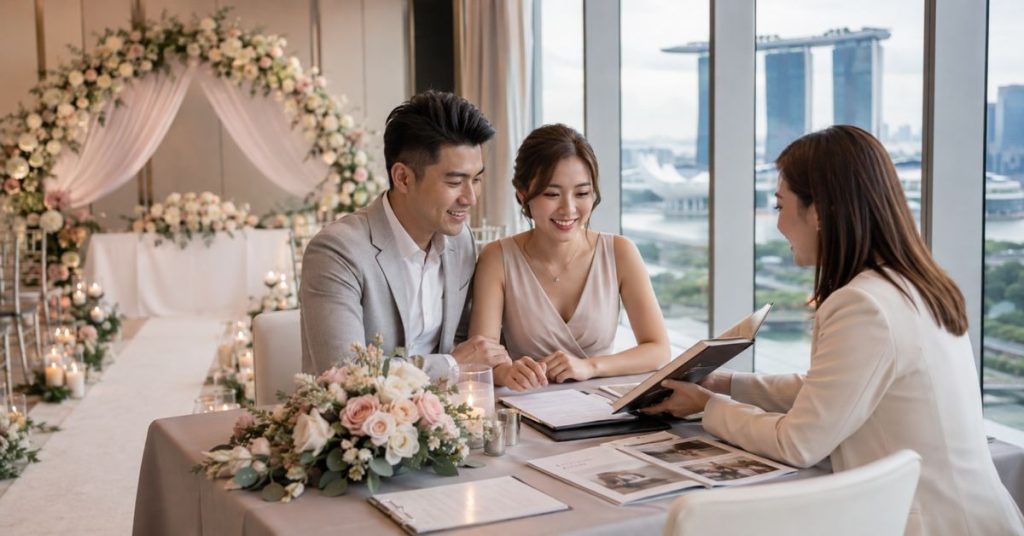
A good solemnisation venue is not just a pretty backdrop. It should reduce coordination pressure. In Singapore, that usually means asking whether the venue can accommodate your ceremony setup, guest holding area, photo flow, meal timing, cultural needs and wet-weather backup without making you manage five different suppliers on the day. If your solemnisation and reception are in the same place, the biggest benefit is usually not luxury. It is continuity. Guests know where to go, vendors know the sequence, and the couple does not lose energy traveling between locations.
Royal Palm @ OCC is a useful local example of that one-location approach. On its wedding events page, the venue says its wedding planners can assist with arrangements including wedding invitations, decorations, and photography, and that it can customise wedding packages across different cultural themes. The same page lists dedicated Malay Solemnisation and Indian Solemnisation options, both from 50 pax onward, alongside larger-format wedding packages. For couples who want the solemnisation and meal planning to happen under one roof, that kind of venue structure can be more practical than piecing the day together across separate locations.
Before you place a deposit, ask questions that reveal how much operational support the venue really gives you:
- Who coordinates directly with your solemniser, Kadi, or Naib Kadi on the day?
- Is there a clear ceremony area, signing table setup, and family photo zone?
- Can the venue handle your guest count without making the solemnisation feel cramped?
- What happens if timing slips by 20 to 30 minutes?
- If you have cultural or dietary requirements, are those already built into the package structure?
- Is there a practical wet-weather or indoor alternative if the original setup changes?
These questions are simple, but they separate a venue that merely hosts events from a venue that actively protects the smooth running of the ceremony.
Final checks and what smart couples do differently
The last week before solemnisation should be about confirmation, not problem-solving. For a civil marriage, that means checking that your solemniser booking is accepted, your declarations are complete, your licence has been issued in the lead-up window, and your solemniser has been reminded at least three days before the ceremony. If you are using a ceremonial certificate, print it early and show your solemniser the version you intend to use. After the solemnisation the official digital certificate is the legal proof of marriage, and civil couples receive it by email after registration.
For Muslim marriages, the same principle applies with a slightly different cast of people: confirm your Kadi or Naib Kadi arrangements, make sure the wali and witnesses are briefed, and keep the necessary IDs and ceremonial items together. The current ROMM materials also warn that if there are changes to solemnisation details on the day, the Kadi or Naib Kadi should be informed before the ceremony begins, because this can affect what appears on your certificates and the follow-up process.
The couples who enjoy their solemnisation most are usually not the ones with the biggest setup. They are the ones who planned in the right order. In Singapore, that means building the day around the legal timeline, requiring people and venue flow first, then layering in the styling, food, and celebration around that solid foundation. Do that well, and your solemnisation feels exactly as it should: meaningful, calm and easy for everyone to be fully present.
FAQs
How early should we apply for a civil solemnisation in Singapore?
You must apply at least 21 days before the solemnisation, and the earliest you can apply is 6 months before the date.
How early should we apply for a Muslim solemnisation in Singapore?
The earliest solemnisation date is 21 days after submission, and the application remains valid for 150 days from the submission date.
Do we need witnesses for the ceremony?
Yes. A civil solemnisation requires the bride, groom, and two witnesses. A Muslim solemnisation requires the groom, bride, wali, and two witnesses.
Can we solemnise outside ROM or ROMM?
Yes. Civil couples can book an offsite solemniser through OMJ and provide the date, time, and venue details. Muslim couples also finalise their solemnisation venue and related details through the official process.
What if one party is a foreigner?
For civil marriages, if any party is not a Singapore citizen or permanent resident, at least one of the parties must have been physically present in Singapore for 31 continuous days before the marriage application is submitted.